One week you are closing deals off pure hustle, a couple warm intros, and a demo you have basically memorized. The next week you are drowning in follow ups, product questions, pricing exceptions, and a pipeline that is technically “full” but also kind of made of vapor.
And then the question hits.
Do I hire my first AE now. Or do I wait until Series A.
I have seen founders hire too early and end up paying a very expensive person to sit around waiting for something resembling a repeatable motion. I have also seen founders wait too long and quietly cap growth because they are the bottleneck for every deal. Both hurt. Just in different ways.
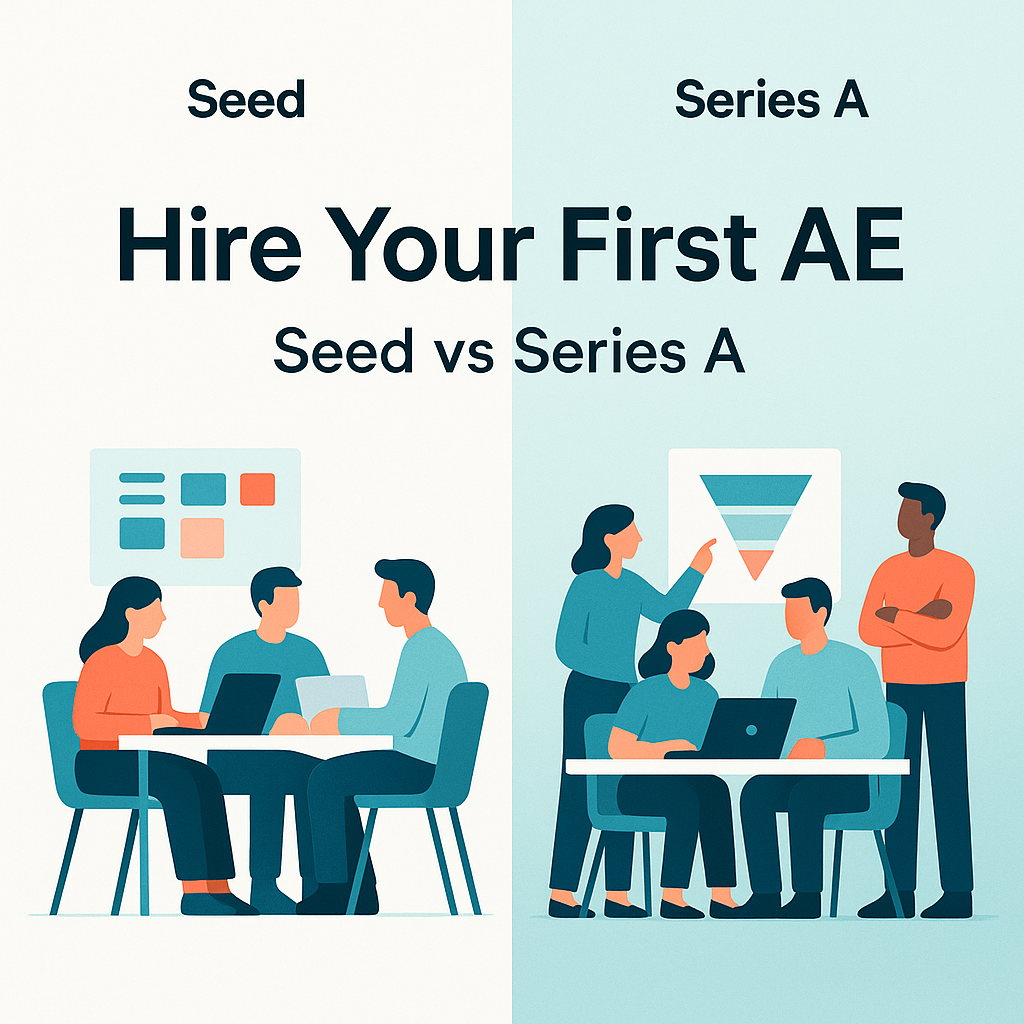
This post is my practical take on when it makes sense to hire your first AE at Seed vs at Series A, and what needs to be true either way.

The real job of your first AE (it is not “to close deals”)
Yes, they will close some deals. Hopefully.
But your first AE is also a systems test. A reality check. A stress test on your positioning, your ICP, your pipeline quality, your onboarding, your CRM hygiene, your pricing, your product packaging. Everything.
If your sales motion is not yet legible to someone else, an AE cannot “execute it”. They will either:
- Make up their own motion, which creates chaos later
- Fail, and everyone concludes “sales doesn’t work for us”
- Win a few deals in a non repeatable way, and you get false confidence
So the decision is less about funding stage and more about readiness. Stage is just a proxy.
Still, Seed vs Series A does change the constraints, the expectations, and the risk you can tolerate. So let’s break it down.
Seed stage: when hiring an AE can work, and when it backfires
At Seed, you are usually in one of these modes:
- You have early traction but it is inconsistent
- You have a handful of lighthouse customers but no clean pattern
- You have a product that sells, but you are still learning who it sells to and why
- The founder is still doing most sales, and also everything else
Hiring an AE at Seed is not automatically wrong. But it is fragile. The margin for error is small because you are still building the machine.
The best reasons to hire your first AE at Seed
Here are the Seed signals that, in the real world, tend to make a first AE hire actually work.
1. You have a repeatable “why we win”
Not a perfect pitch deck. Not a fancy narrative.
A repeatable reason.
You can say, with a straight face:
- We win when the buyer is this role
- They have this painful trigger event
- They care about these 2 to 3 outcomes
- We beat alternatives because of these 1 to 2 differentiators
- The deal usually dies for these reasons
If you cannot articulate that yet, you can still hire. But you are not hiring an AE, you are hiring a very expensive explorer. Different role, different profile.
2. You can generate a predictable number of qualified sales conversations
This is the one founders try to skip.
If your calendar is empty and you hire an AE, the AE will also have an empty calendar. Then the real problem becomes obvious: top of funnel.
As a rough rule, you want the business to be able to create enough qualified meetings so an AE can run at least 8 to 12 first calls a week, depending on deal complexity. If you cannot do that yet, you may need to solve distribution before you scale closing capacity.
3. You have a baseline sales process, even if it is messy
You do not need perfection. You do need something.
- Lead stages that mean something
- A definition of qualified
- A basic pipeline review rhythm
- A way to run discovery, demo, next steps
- A way to forecast, even if it is “gut plus spreadsheet”
If everything is tribal knowledge in your head, onboarding will be slow and the AE will drift.
4. You are personally willing to coach daily for 60 to 90 days
Seed AEs do not come in and magically “take sales off your plate”. Not at first.
Expect to:
- Join calls
- Review recordings
- Help write sequences
- Debrief deals
- Approve pricing and packaging decisions
- Fix CRM fields you did not know were broken
If you cannot make time for that, pause. Because hiring an AE without investing in enablement is basically hoping.
When a Seed stage AE hire backfires
This is the pattern I see over and over.
You hire because you are tired
Being tired is real. But it is not a strategy.
If you hire an AE mainly to reduce your workload, you will likely be disappointed. Early on, a first AE increases your workload. Training, feedback, process, reviewing every deal. It is a lot.
Your product is still changing weekly
If the pitch, pricing, or product surface area is changing constantly, the AE never stabilizes. They will feel like they are selling a moving target. Which they are.
You do not know your ICP yet
If you are still saying “our ICP is mid market and enterprise”, that is not an ICP. That is a hope.
AEs need a narrow lane to run in, especially the first one.
You think “a great AE will figure it out”
Sometimes they do. More often they do not. And even if they do, they may build a motion you cannot replicate.
Seed is not the time to bet your entire go to market on someone else’s intuition.

Series A stage: why it becomes easier, and also more dangerous
By Series A, the expectation shifts.
You are no longer proving “can this be sold”. You are proving “can this scale”.
Usually that means:
- Clearer ICP and positioning
- More consistent inbound or outbound performance
- A defined sales cycle, even if it still varies
- More pressure on forecast and growth targets
- More stakeholders involved internally
Hiring your first AE at Series A is often safer because there is more signal and more structure. But it is also more dangerous because mistakes are more expensive. The board expects progress. The burn is higher. And “we are still figuring it out” starts to wear thin.
The best reasons to hire your first AE at Series A
1. Founder led sales is now a bottleneck
This is the cleanest reason.
You have more demand than you can handle, and deals are slipping because the founder cannot respond fast enough, cannot run enough calls, cannot follow up properly, cannot multi thread.
If you are seeing:
- slow response times
- long gaps between meetings
- pipeline reviews that never happen
- proposals that go out late
- deals dying because of “no next step”
That is not a talent problem. That is a capacity problem. Hire.
2. You have enough data to define success
At Series A you should be able to say:
- target ACV range
- target win rate
- average sales cycle
- expected activity levels
- expected conversion rates per stage
Even if the numbers are imperfect, you can set a scoreboard. That makes the AE hire much more manageable.
3. You are ready to standardize the motion
This is the big shift.
At Series A, you should be thinking about:
- a documented playbook
- consistent qualification, often MEDDPICC or similar
- consistent discovery and demo flow
- a clear handoff to onboarding or CS
- regular pipeline inspection and forecasting
Your first AE at Series A is not just a seller. They are also the first real user of your sales operating system.
If you do not have that operating system yet, you can still hire, but you will get messy results. And then you will hire a second AE and multiply the mess.
When waiting until Series A is actually the right call
Some founders force an AE hire at Seed because “that is what you do”. But honestly, waiting can be smart if:
- your product is still finding its wedge
- your ICP is still unclear
- you are still iterating pricing and packaging
- you cannot consistently create qualified pipeline
- you are still learning how to run a sales process end to end
In that phase, a founder can move faster than any hired rep. Founders can change the pitch mid call. They can promise weird things. They can call an engineer into the meeting. They can bend reality a little. That is sometimes what it takes to find product market fit.
AEs are not built for that chaos. Not most of them.
The Seed vs Series A decision in one sentence
If you want the simplest framing:
- Hire your first AE at Seed when you have a narrow ICP and a repeatable motion, and you need capacity.
- Hire your first AE at Series A when you need to scale a motion that already works, and you are ready to standardize it.
Everything else is nuance.
So let’s get into the nuance.

A practical readiness checklist (use this before you open the role)
If you are unsure, run this checklist. Be honest.
Pipeline and demand
- You can consistently generate qualified meetings without heroics
- You know your top 2 channels for pipeline creation
- You have at least 2 to 3 months of pipeline history you trust
ICP and messaging
- You can describe your ICP in one sentence
- You know the common trigger events that create urgency
- You know the top objections and how you answer them
- You can explain why you win vs alternatives
Sales process and qualification
- You have defined stages that match buyer reality
- You have a qualification framework, even a lightweight one
- You know what a “qualified opportunity” actually means
- You have a consistent demo and next steps flow
Enablement and management
- You have a CRM that you actually use
- You can run a weekly pipeline review
- You can provide call recordings and examples
- You can coach at least 3 to 5 hours per week early on
If you cannot check most of these, it does not mean “do not hire”. It means your first hire may need to be different.
Which leads to the next point.
Maybe you do not need an AE yet (common alternatives)
A lot of founders think the only options are:
- founder sells
- hire AE
There is a middle ground.
Option 1: Hire a SDR first
If the biggest issue is meetings, not closing, an SDR can make sense first.
But only if you have:
- a clear ICP
- a message that gets replies
- a founder who can close
Otherwise you will just create low quality meetings that waste everyone’s time.
Option 2: Hire a sales operator or fractional sales leader
This is underrated.
If your biggest issue is process, CRM, qualification, or turning tribal knowledge into a system, you may need sales infrastructure before you add headcount.
This is literally what we do at David Consulting Services. The whole point of the 90 Day Method is to extract what is in the founder’s head, turn it into a usable playbook, fix the pipeline and CRM plumbing, and then help you hire and ramp the first 1 to 3 reps without setting money on fire.
Not a huge “consulting deck” thing. More like, let’s build the operating system and then hire into it.
Option 3: Hire a “hybrid” first seller (AE plus outbound)
Some startups hire a rep who can prospect and close.
This can work at Seed when pipeline is thin. But be careful with expectations. Doing both well is hard. If you go this route, narrow the ICP even more and give them a tight list and tight messaging.
What profile should your first AE be (Seed vs Series A)
The profile changes by stage. This is where a lot of founders miss.
Seed stage first AE profile
At Seed, you want someone who can operate without a lot of structure, but who is still coachable.
Look for:
- comfort with ambiguity
- willingness to do unglamorous work
- strong discovery skills
- tight written communication
- founder level curiosity about the product and market
Be cautious with:
- “enterprise only” AEs who need a full machine around them
- reps who blame pipeline for everything immediately
- reps who rely on brand power or inbound only
Series A first AE profile
At Series A, you want someone who can run a process and hit a number, and who will not reinvent your motion every week.
Look for:
- consistent quota performance in a similar motion
- strong pipeline management
- forecasting discipline
- ability to follow a playbook and improve it
- experience with your deal size and cycle
Be cautious with:
- “I only do my thing” reps
- reps who cannot explain how they qualify or why deals slip
- reps who oversell and create churn later
Compensation and expectations (quick reality check)
A first AE is expensive. Even more expensive when you include ramp time and management time.
A few practical points:
- Plan for a 3 to 6 month ramp depending on complexity
- Expect early pipeline to be messy
- Do not over promise OTE if you cannot support attainment
- Make sure the variable comp matches what you actually want them to do
Also, set expectations internally. Your first AE will not instantly create predictability. They are part of how you create it.
The biggest mistake: hiring an AE before you have a sales playbook
You do not need a 60 page document.
You do need something written down that a rep can follow on Monday morning.
At minimum:
- ICP definition and disqualifiers
- messaging pillars and proof points
- discovery questions and qualification checklist (MEDDPICC, SPIN, Sandler, whatever you use)
- demo outline
- common objections and responses
- pricing and packaging guidelines
- CRM stage definitions
- handoff process to onboarding or CS
If that sounds like a lot, yeah. It is.
But it is still less work than cycling through two failed AEs and wondering why sales is so hard.
So… Seed or Series A. What should you do
If you are at Seed and considering it, ask yourself:
- Are we hiring because we have demand and a repeatable motion, or because we are tired and hopeful
- Can we feed this person enough qualified at bats
- Can we coach like crazy for 90 days
If you are at Series A and considering it, ask:
- Is the founder now the bottleneck
- Do we have a defined process we can standardize
- Are we ready to manage to numbers, not vibes
And if you are stuck in the middle, where the motion kind of works but it is not written down and the CRM is a mess and forecasting is a guess…
That is usually the moment to slow down for a second and build the foundation.
If you want help doing that, take a look at David Consulting Services and the 90 Day Method here: https://www.davidconsulting.services. It is built specifically for this transition. Founder led sales into a team driven engine, without losing what made founder led sales work in the first place.
Quick wrap up
Hiring your first AE is not a stage based milestone. It is a readiness milestone.
Seed hires work when you have a narrow ICP, repeatable wins, and enough demand to keep the rep busy. Series A hires work when you are ready to standardize and scale a motion that already works, with real process and real management.
And if you are not ready yet, that is fine. But do not guess. Get clear on what is missing, fix that, then hire.
Because the goal is not “we hired an AE”.
The goal is revenue that shows up even when the founder is not in every single call.
FAQs (Frequently Asked Questions)
What is the primary role of the first Account Executive (AE) in a founder-led sales startup?
The first AE is not just there to close deals but serves as a systems test, reality check, and stress test on your positioning, ideal customer profile (ICP), pipeline quality, onboarding, CRM hygiene, pricing, and product packaging. They help validate whether your sales motion is legible and repeatable for someone else to execute.
When is it appropriate to hire your first AE at the Seed stage?
Hiring an AE at Seed works best when you have a repeatable 'why we win' narrative, can generate a predictable number of qualified sales conversations (8-12 first calls per week), possess a baseline sales process even if messy, and are willing to personally coach the AE daily for 60 to 90 days. These conditions indicate readiness beyond just funding stage.
What are common pitfalls of hiring an AE too early during the Seed stage?
Hiring too early often happens when founders hire because they are tired rather than strategic, have a product that changes weekly causing instability, lack a clear and narrow ICP, or believe a great AE will figure everything out. This can lead to wasted resources, chaos in sales motions, and false conclusions that sales don't work for the business.
Why should founders be cautious about hiring their first AE before reaching Series A?
Before Series A, the sales process may still be immature or inconsistent. Hiring an AE prematurely can result in paying an expensive employee who waits for repeatable motions that don't yet exist. Conversely, waiting too long makes founders bottlenecks for every deal. The key is balancing readiness with risk tolerance based on your business's specific signals rather than just funding stage.
How does having a predictable pipeline impact hiring your first AE?
A predictable pipeline ensures that an AE has enough qualified meetings—ideally 8 to 12 first calls per week—to work on. Without this top-of-funnel consistency, an AE’s calendar will be empty, leading to poor performance and frustration. Addressing distribution challenges before scaling closing capacity is critical for successful AE onboarding.
What level of involvement should founders expect when onboarding their first AE at Seed stage?
Founders should be prepared to invest significant time coaching their first AE daily for 60 to 90 days. This includes joining calls, reviewing recordings, helping write outreach sequences, debriefing deals, approving pricing and packaging decisions, and fixing CRM issues. Early AEs do not immediately reduce founder workload; instead, they require active enablement to succeed.