
Ready to build a sales team
that works without you?
Book a free 20-minute conversation. No pitch — just an honest look at your sales process and whether I can help.
Book a Free Consultation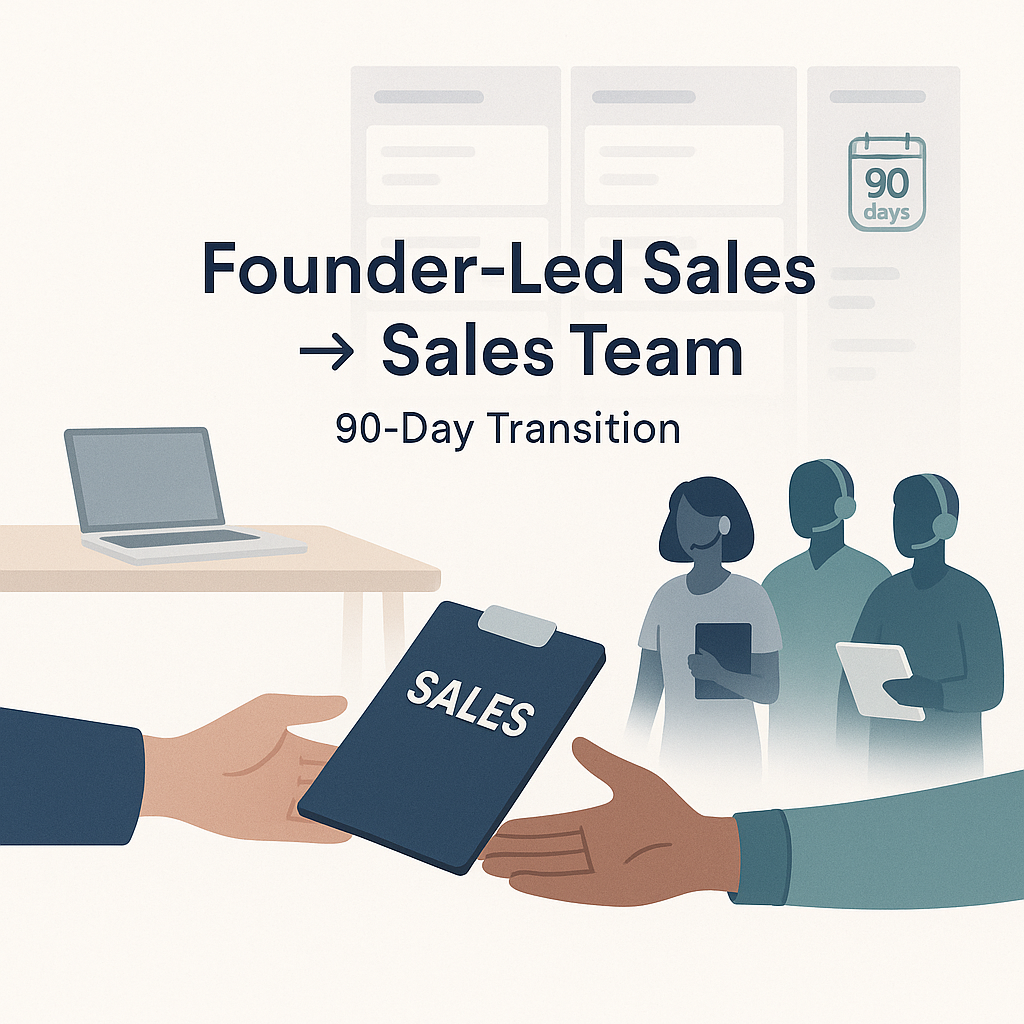
Meta description (suggestion): A practical 90-day plan to transition from founder-led sales to a sales team, with playbook, hiring, training, and handoff steps.
If you’re searching for how to transition from founder-led sales to a sales team, you’re probably already feeling the pain.
Your calendar is a wall of demos. Pipeline reviews feel like personal judgment. Deals stall the second you stop pushing. And the worst part is you can’t tell if growth is real or just your willpower.
I’ve watched this movie for 23 years across enterprise B2B. When I was building and scaling teams across 30+ markets, I saw the same pattern: founder-led sales works until it becomes the bottleneck. Then it quietly starts killing your product velocity, hiring, and sanity.
The fix is not “hire a killer closer” and hope.
The fix is to extract what you do, turn it into a system, then hire and train reps to run that system. That’s what we do at David Consulting Services. It’s not theory. It’s a 90-day build designed to remove you from day-to-day selling.
Let’s talk about how to do it for real.
Founder-led sales is your unfair advantage early on.
You can tell the story with conviction. You know the product tradeoffs. You can negotiate edge cases on the fly. You can call a CTO’s bluff because you’ve lived the problem.
But founder-led sales has a ceiling. Not because you’re bad at sales. Because you’re one human.
If you’re doing 5 to 15 demos a week, you’re not “scrappy.” You’re stuck. You’re the revenue engine, the sales manager, the enablement function, and the escalation path.
That’s not a company. That’s a founder with a checkout link.
Here’s the hard truth: your goal is not to sell. Your goal is to build a machine that sells without you.
Most founders hire reps before they have a repeatable process.
So the rep shows up on Day 1 and asks:
And the founder answers with vibes, war stories, and a few scattered docs.
So the rep starts improvising. Activity goes up. Pipeline gets messy. Forecast becomes fantasy. The founder jumps back into deals to “save” them. Now you’re paying a salary so you can keep doing the same job.
You didn’t hire a rep. You hired a distraction.
You need a playbook first. Not a 60-page corporate manual. A working system that turns your instincts into steps.
This is the exact structure we run inside David Consulting Services: a 90-Day Founder-to-Team Sales Build at $2,000/month USD.
It’s three months for a reason. Month 1 is system. Month 2 is people. Month 3 is execution and handoff.
If you try to compress it, you skip the hard parts and end up back in founder-led sales.
By the end of 90 days, you should have:
Now let’s break down how to do it.
Month 1 is not “document some things.” It’s extraction. We pull the sales motion out of your head and put it into a format other humans can run.
This is where founders resist. Because it feels slower than just doing another demo.
But if you don’t do this, every hire becomes expensive guesswork.
Here’s what Month 1 should include.
Not “mid-market SaaS.”
I mean the deals you actually win with the least drama.
If you can’t answer that, you don’t have an ICP. You have hopeful targeting.
You’re probably doing decent discovery without realizing why.
We structure it so a rep can run it cleanly. You can use MEDDPICC, SPIN, Challenger, Sandler. I don’t care which label you prefer. I care that your rep can:
A rep who can’t qualify will “build pipeline” that never closes.
Founders often pitch like this:
That’s not a sales narrative. That’s a product tour.
You need a tight story: problem, stakes, why now, why you, proof, next step.
If your CRM stages are just “Discovery, Demo, Proposal,” you’re blind.
Each stage needs exit criteria. Example:
This is how you stop pipeline reviews from becoming therapy sessions.
Reps don’t fail because they can’t talk. They fail because they don’t have ammo.
At minimum, give them:
Month 1 ends when your sales process is clear enough that a smart rep can follow it without you improvising in Slack.
Now you hire.
Not earlier.
And no, you don’t start by hiring a senior sales leader. If the motion isn’t documented, you’ll pay for a title while still doing the work yourself.
Month 2 is about getting the right people and setting expectations.
Early reps in Seed to Series A need to learn fast, run a process, and handle rejection without falling apart.
You don’t need a rep who says they “crush quota.” You need a rep who can:
If they can’t do those things, they will drag you back into every deal.
You should require:
You’re testing how they think and communicate. Not how well they perform in small talk.
Training is not “shadow my calls for two weeks.”
Training is:
If they go live too early, they learn bad habits. If they stay in shadow mode too long, they never build confidence.
You want a tight ramp with clear gates.
Month 3 is where most founders blow it.
They either micromanage every email, or they disappear and hope it works out.
Neither works.
Your job in Month 3 is to coach the reps through real deals while you shift into management mode.
A good deal review is not “so, how’s it going?”
It’s:
If the rep can’t answer, the deal isn’t real yet.
This is where structured methods like MEDDPICC shine. Not as theory. As a way to expose gaps early.
Reps avoid pressure because they don’t want to lose the deal.
But pressure is what qualifies the deal.
A rep needs to be able to say:
This is how you keep deals from stalling.
You will still show up sometimes. But it should be deliberate.
Use yourself as:
Not as the person who runs discovery, demo, follow-ups, proposal, and negotiation.
If you keep “saving” deals, your reps never learn to close. And you never get your time back.
Here’s a simple rhythm founders can stick to:
Your goal is boring consistency. That’s what scales.
You’re not removed from revenue. You’re removed from the day-to-day grind.
You’ll know it’s working when:
I’ve seen founders fight this transition because selling is where they feel most in control. I get it. When I was building teams, I also liked being the person who could pull a deal across the line.
But control isn’t the goal anymore. Scale is.
A sales team doesn’t fail because people don’t work hard.
It fails because nobody knows what “good” is.
The 90-day approach forces sequence:
This is how you get faster rep ramp times and better win rates, because reps aren’t guessing. They’re executing a proven motion.
That’s also why David Consulting Services is built the way it is. David has 23 years of enterprise B2B sales experience, has closed over $20M across 30+ markets, and trained teams for global enterprises. The point isn’t the resume. The point is the system has been pressure-tested.
If you want help building this in your company, start here: David Consulting Services.
And if you want to talk it through, book a free 20-minute consult: https://calendly.com/judedavid-davidconsulting/20min.
A clean transition usually takes about 90 days: 30 days to systematize the founder’s sales process, 30 days to hire and train reps, and 30 days to coach reps through first deals and shift the founder into sales management.
Document your ICP, sales narrative, discovery call flow, qualification criteria, pipeline stages with exit criteria, objection handling, pricing guardrails, and a close plan template. This becomes the sales playbook reps follow.
You’re ready when you can explain how you win in a repeatable way and document it as a sales playbook. If reps would need you on every call to understand the process, you’re not ready yet.
Step out gradually by using the written playbook, training reps with roleplays and call coaching, and staying involved only as an executive sponsor on late-stage deals. The goal is for reps to run the process while you manage and coach instead of closing everything yourself.
Founder-led sales works well initially because of your deep product knowledge and conviction, but it becomes a bottleneck as your company grows. Staying founder-led limits scalability, product velocity, hiring, and overall sanity. Transitioning to a sales team builds a machine that sells without relying solely on you.
The biggest mistake is hiring reps before having a repeatable sales process. Without a clear playbook or system, reps start improvising, leading to messy pipelines and unreliable forecasts. This often forces founders back into deals, negating the purpose of hiring and creating distractions instead of growth.
The 90-day plan includes three phases: Month 1 focuses on systematizing your current sales process; Month 2 involves hiring and training 1 to 3 reps against the developed playbook; Month 3 centers on execution and handing off day-to-day selling to your new team while you operate as a sales manager.
Defining your ICP means identifying the customers you actually win with the least resistance—not vague categories like 'mid-market SaaS.' Focus on who buys fastest, expands easily, requires fewer custom features, and champions your product internally. A precise ICP guides targeted and efficient selling.
A repeatable discovery script should enable reps to qualify prospects effectively without awkwardness by surfacing real pain points and urgency, mapping stakeholders and decision processes, tying outcomes to business impact, and confirming technical and security requirements early. Using methodologies like MEDDPICC or SPIN can help structure this.
An effective sales narrative should be concise and compelling, covering the problem your product solves, the stakes involved for the prospect, why now is the right time to act, why your solution stands out, proof points such as customer success stories or data, and a clear next step. Avoid lengthy feature tours in favor of storytelling that drives urgency and trust.
Book a free 20-minute conversation. No pitch — just an honest look at your sales process and whether I can help.
Book a Free Consultation