
Ready to build a sales team
that works without you?
Book a free 20-minute conversation. No pitch — just an honest look at your sales process and whether I can help.
Book a Free Consultation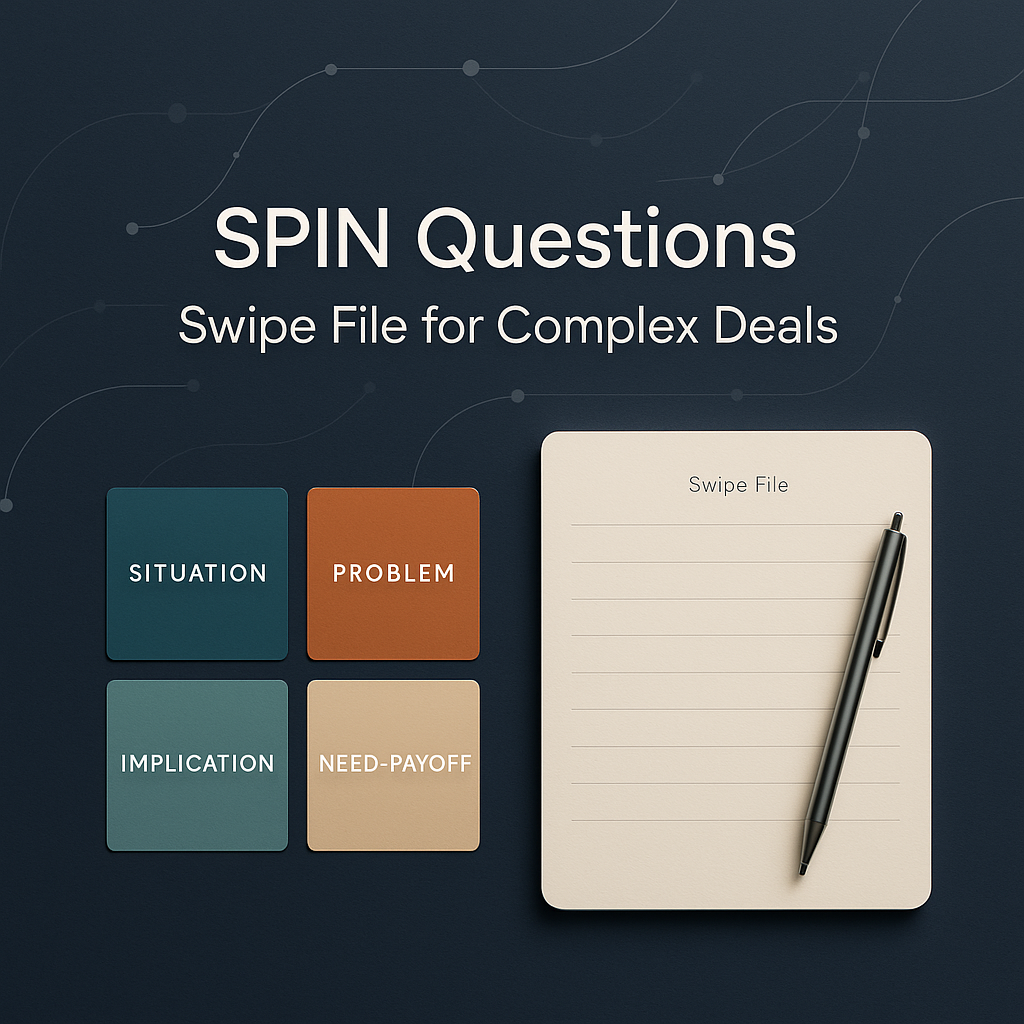
If you sell complex B2B deals, multi stakeholder, long cycle, security review, the whole circus. You cannot wing it. Not for long.
Because complex deals don’t usually die from price. They die from fuzzy problem definition. From the buyer not feeling urgency. From you building a “solution” around the wrong pain. Or around one person’s opinion, while the real decision is happening somewhere else.
That’s why SPIN still holds up. It’s not trendy, it’s not shiny. It’s just… reliable. A way to ask questions that move the buyer from “interesting” to “we need to fix this.”
This is a swipe file you can steal. Copy the questions, paste them into your discovery doc, and tweak the words to match your product and your market.
SPIN is a questioning framework:
Most reps overdo Situation questions (it’s safer). The best reps spend more time in Implication and Need payoff because that’s where urgency and ROI come from.
Also. SPIN is not a script. It’s a ladder. You climb it with the buyer.
Use it when:
Don’t use it like a robot when:
You can still use SPIN late stage, just shorten it. Ask 2 to 3 sharp questions, not 25.
If you want the shortest usable structure, it’s this:
That’s it. The rest is just good questions.
Situation questions are for orientation. Not interrogation. If the answer is on LinkedIn, in their job post, or in their last earnings call. Skip it.
Image: Add a simple SPIN funnel diagram (Situation -> Problem -> Implication -> Need Payoff).
Suggested filename: spin-funnel.pngAlt text: SPIN questioning funnel for complex B2B discovery
This is where you get specific. Not “what keeps you up at night?” but “where does it break?”
Implication questions turn “annoying” into “costly.” This is also where you help the buyer build the story they need for internal buy in.
Keep it calm. Curious. Almost like you’re doing a diagnosis, not a pitch.
In this context, it's useful to reference some research on how these types of questions can impact decision-making. A study published in a PMC article provides valuable insights into this area.
Image: Add a “cost of inaction” calculator style screenshot or simple table graphic.
Suggested filename: cost-of-inaction-table.pngAlt text: Cost of inaction table for complex B2B buying decisions
Need payoff questions help the buyer describe value in their own words. That matters because the champion has to sell this internally when you’re not in the room.
Sometimes you don’t want a giant list. You want a small bundle you can run on a call. So here are a few.
Goal: uncover if there is real pain, and if there is urgency.
Goal: earn the right to demo by diagnosing first.
Goal: map pain across functions and build consensus.
Goal: isolate decision criteria and reduce “same same” comparisons.
When you get the usual pushback, instead of providing a counterargument, try asking a question that redirects back to the core problem at hand. This approach can be particularly useful when navigating through tough decisions; as highlighted in this guide on how to make a tough decision, breaking down the decision and listening to your gut can often lead to better outcomes.
A tiny cheat sheet.
If you’re asking 12 Situation questions on a late stage call, buyers feel it. They get impatient. And they should.
If you want to operationalize SPIN across a team, give reps a one page template they can actually use. Here’s a simple one.
Situation:
Problems (top 3):
1.
2.
3.
Implications:
Need payoff / desired outcomes:
Next steps (mutual plan):
Image: Add a screenshot mockup of this template in a doc.
Suggested filename: spin-discovery-template.pngAlt text: SPIN discovery notes template for complex sales calls
Founders are often good at SPIN naturally. Not because they studied it, but because they built the product and they know where it hurts.
The problem is consistency. Once you hire the first 1 to 3 reps, discovery quality becomes… random. Everyone asks different questions, you get different deal notes, forecasting becomes vibes, and then you wonder why conversion dropped.
This is exactly the kind of thing we bake into a sales playbook during the 90-Day Method at David Consulting Services. We take what works in founder-led calls, turn it into a repeatable discovery and qualification approach, then train reps on it and reinforce it in live deals.
If you want help turning this swipe file into an actual system your team runs every week, you can check out David Consulting Services at https://www.davidconsulting.services and book a consult.
You don’t need “better questions.” You need the right sequence.
Print the list. Highlight 10 that fit your product. Use them until they sound like you.
That’s the whole game.
SPIN is a questioning framework designed for complex B2B sales involving multiple stakeholders and long sales cycles. It stands for Situation, Problem, Implication, and Need payoff. This method helps sales reps move buyers from mere interest to recognizing an urgent need to fix a problem by asking targeted questions that uncover pain points, costs of inaction, and value of change. Unlike trendy scripts, SPIN is reliable and adaptable to various markets and products.
Use SPIN during discovery phases when the deal size is significant, multiple functions are involved (like Ops, IT, Finance), a business case needs to be built beyond just a demo, or when buyers are comparing similar vendors. Avoid using it robotically if the buyer already has a clear problem statement or timeline or during late-stage calls where confirmation rather than exploration is needed. In late stages, shorten SPIN questions to 2-3 sharp inquiries.
A simple discovery flow with SPIN includes: 1) Confirming context with minimal Situation questions; 2) Identifying pain points through Problem questions; 3) Highlighting the cost and risk of unresolved issues via Implication questions; 4) Making the future benefits concrete with Need payoff questions; and 5) Locking in next steps with a mutual plan. This ladder approach helps build urgency and ROI clearly.
Effective Situation questions focus on orientation rather than interrogation—avoid information easily found on LinkedIn or public sources. Good examples include asking about top team priorities this quarter, recent changes prompting the meeting, project priority relative to other initiatives, ownership of outcomes, current workflows and tools in use, data trust points, team handoffs, stakeholder involvement across departments like IT or Finance, past buying processes, and timelines driving decisions.
Problem questions aim to identify specific frictions such as manual workflows, bottlenecks, mistrust in processes, performance gaps (speed, quality), internal disagreements, resistance to change, and prior attempts at fixes. Implication questions then escalate these problems by exploring costs when issues occur—time lost, money wasted, customer trust damaged—and frequency of these events. This deepens urgency by helping buyers realize the true impact of unresolved problems.
Yes. Examples include: 'When this process breaks down, what costs do you incur in terms of time or money?', 'How often do these failures happen realistically?', 'What risks do these issues pose to customer satisfaction or retention?', 'If nothing changes soon, how might this affect your team's goals or company reputation?' These calm yet probing questions help buyers quantify pain points and build internal justification for change.
Book a free 20-minute conversation. No pitch — just an honest look at your sales process and whether I can help.
Book a Free Consultation