
Ready to build a sales team
that works without you?
Book a free 20-minute conversation. No pitch — just an honest look at your sales process and whether I can help.
Book a Free Consultation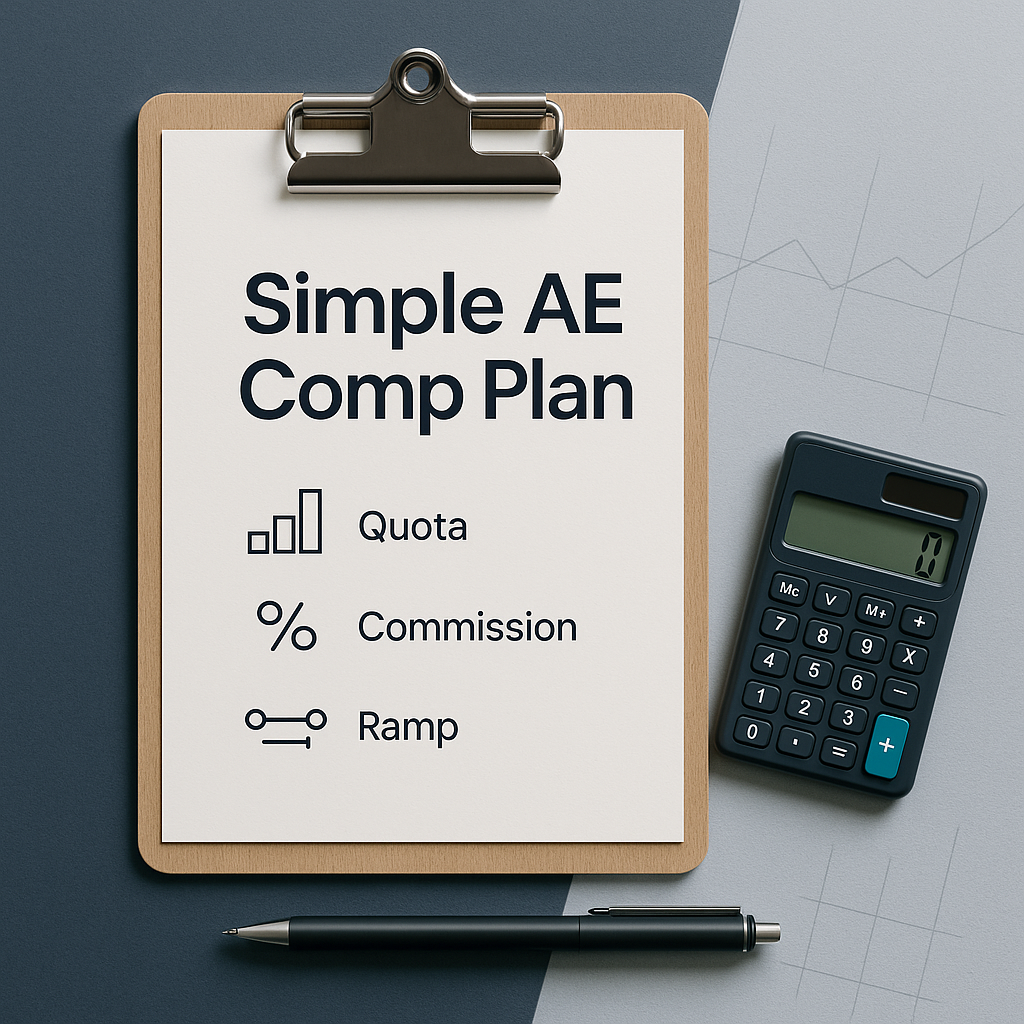
And then you hit the weird part that no one warns you about.
You need a comp plan.
Not a 12 tab spreadsheet with accelerators that look like a casino game. Just something that works, doesn’t blow up your cash, and doesn’t accidentally teach your AE to chase the wrong deals.
This post is for early stage B2B startups hiring the first one or two AEs, especially if you’re coming out of founder led sales and you’re still figuring out your ICP, your cycle, your pricing, all of it.
Simple plans. Simple math. Fewer surprises.
Founders usually do one of these:
The first AE is not a late stage sales hire. You don’t have predictable lead flow. Your product is still moving. Sales cycles vary. Some deals are basically consulting. Some are tiny. Some are too big and pull you off roadmap for three months.
So the comp plan has to do a different job.
It needs to:
If you only take one thing from this article, take this:
Start with a clean split between base and variable, tie variable to one measurable outcome, add only one or two guardrails, then review it every quarter.
That’s it.
The rest is just choosing the right outcome and choosing numbers that won’t wreck your runway.
This is where most founders accidentally create chaos.
You need to decide which event triggers commission. Pick one.
Common options:
This is the default for a lot of SaaS teams.
Pros
Cons
Usually used when cash is tight or payment risk is real.
Pros
Cons
This works for implementation heavy products.
Pros
Cons
Simple recommendation for first AEs
You’ll hear these terms a lot:
For first AEs, the most common simple split is:
If you’re pre Series A or early Series A and still figuring things out, 50 50 is usually the least controversial.
It signals. Yes we’re serious about upside. Also yes we know this is messy.
Here’s the starter plan.
At 100% quota, they earn $70,000 variable.
So commission rate on ARR is:
$70,000 / $420,000 = 16.67% of ARR
If that sounds high, remember this is early stage and you’re buying learning, process building, and pipeline creation. Not just closing.
You can also set quota lower or raise OTE. But keep the math clean.
Your first AE needs ramp. Even if they’re experienced.
If your average sales cycle is 45 to 90 days, they can’t “produce” immediately. So give them a ramp guarantee or a reduced quota.
Two simple ramp options:
Example:
This is easy and feels supportive. Also helps you recruit.
Example:
Either is fine. Just write it down.
You do need guardrails, but founders usually go too far.
Here are the only two that matter early on.
Like discounts above X%, payment terms longer than Y, or custom scope.
This prevents the AE from “winning” a deal that you can’t deliver profitably.
If a customer cancels within, say, 60 or 90 days, you can claw back commission.
Keep it short. If your onboarding takes 120 days, your company has a bigger issue than comp design.
If you’re worried about churn or delivery risk but you still want to pay on bookings, do this:
It feels fair. AE gets rewarded for closing, and you protect the business a bit.
Also it reduces arguments because the structure is transparent.
For your first AE. Keep this simple.
A clean model:
That’s enough.
Decelerators under quota are usually a bad idea early on. It makes reps hide bad news. You want visibility, not fear.
A common founder mistake is paying for:
That’s five comp plans in a trench coat.
Pick one primary metric. For AEs, it should almost always be closed won ARR.
If you need meetings booked, hire an SDR. Or make pipeline generation part of expectations, not commission.
Yes, your first AE might have to prospect. But you still pay them like an AE.
Instead of complicated “draws” and punishment mechanics, set a basic expectation like:
It’s not legal language. It’s clarity.
And it matters because early hires can drift if they don’t feel urgency.
Write this down upfront. Even if it’s just two bullets.
Keep it simple. A common rule:
The goal is to avoid resentment, not to perfectly measure effort.
Quotas are guessy early on. That’s fine.
Just don’t make them fantasy.
Three inputs to keep you grounded:
If your current average deal is $12k ARR and cycle is 60 days, one AE closing $40k ARR per month might be unrealistic unless you have a machine.
Start conservative, then tighten after you see 2 quarters of data.
If this is going on your site, visuals help. Even simple ones.
Here are a few image placements that work well on WordPress.
Upload a simple pie chart or bar chart showing base vs variable.
md
Make a small table in Google Sheets and screenshot it.
md
A basic timeline graphic for split payouts.
md
If you don’t have these images yet, even placeholders are fine while you build the post. Just replace the URLs later.
This part is blunt, but useful.
If you must change it, do it next quarter. And explain why.
If the AE feels “gotcha’d” once, trust is gone.
If you pay on activation, but onboarding is chaotic, they will stop trusting the plan.
If they can’t estimate their paycheck in 60 seconds, they will assume the worst.
I get it. But comp plans don’t create demand. They just aim effort.
Do a 30 minute kickoff, and send a one pager.
Agenda:
Then ask them to explain the plan back to you. If they can’t, it’s too complex.
At David Consulting Services this is a very normal part of the shift from founder led sales to a real sales engine. Not just “make a comp plan”, but making sure it matches your stage, your cash, your CRM, your pipeline math, and the reality of your current motion.
If you’re hiring your first 1 to 3 reps and want to avoid the common traps, you can look at the 90 Day Method on the site and book a consult here:
https://www.davidconsulting.services
You can literally paste this into a doc.
Role: Account Executive
Plan Start Date: [date]
OTE: $140,000
Base: $70,000
Variable: $70,000
Quota: $420,000 ARR per year (or $35,000 ARR per month)
Commission: 16.67% of Closed Won ARR credited to AE
Payout Timing: 50% on signature, 50% on first invoice paid
Ramp: First 3 months reduced quota: 0%, 25%, 50% then full quota
Approvals Required: Discounts over [X%], payment terms over [Y days], or any non standard contract terms
Clawback: If customer cancels within 60 days, commission may be clawed back as per the sales commission clawbacks policy.
That’s it.
Not perfect. But workable. And you can evolve it once you have real data, and a repeatable motion, and a second AE.
Which is the whole point.
First AE comp plans get messy because founders tend to copy 'standard SaaS plans' that aren’t really standard, overpay base salaries out of fear of churn and ramp, underpay commissions due to cash constraints, add numerous complex rules that make AEs feel tricked, or pay commissions on bookings despite uncertain revenue. Additionally, early-stage sales involve unpredictable lead flow, varying sales cycles, and diverse deal sizes, requiring a different approach to comp planning.
The simplest working comp plan framework involves starting with a clean split between base and variable pay, tying the variable portion to one measurable outcome, adding only one or two guardrails, and reviewing the plan every quarter. This approach keeps things straightforward and adaptable as your startup evolves.
Founders need to pick one clear event for triggering commissions: paying on signed contracts (bookings) is common for standard SaaS with decent retention; paying on cash collected protects cash flow but may frustrate AEs; paying on activation or 'go live' aligns sales with successful onboarding in implementation-heavy products. Choosing the right 'crediting' method is crucial to avoid chaos and misaligned incentives.
Typical base-to-variable splits include 50/50 for higher-risk early-stage roles where sales are less predictable; 60/40 when there’s better inbound flow and stronger product-market fit; and 70/30 if sales are mostly order-taking (rare at early stage). For pre-Series A or early Series A startups still figuring things out, a 50/50 split signals seriousness about upside while acknowledging messiness.
A starter comp plan might have an On Target Earnings (OTE) of $140,000 split evenly as $70,000 base salary and $70,000 variable at 100% quota attainment. With a quota set at $420,000 ARR per year, this yields a commission rate of approximately 16.67% of ARR. This structure reflects buying learning and pipeline creation in early-stage selling rather than just closing deals.
Including a ramp period acknowledges that even experienced AEs cannot immediately produce due to average sales cycles ranging from 45 to 90 days. Providing a ramp guarantee or reduced quota during initial months helps manage expectations and supports AE performance without undue pressure from month one.
Book a free 20-minute conversation. No pitch — just an honest look at your sales process and whether I can help.
Book a Free Consultation