You open your CRM and it is like. 42 fields. 9 stages. A bunch of charts that look impressive. And somehow you still do not know the one thing you actually need to know.
Are we on track to build a repeatable sales motion. Or are we just getting lucky.
The truth is you do not need 20 metrics right now. You need three. Three that tell you if the inputs are healthy, if the pipeline is real, and if revenue is starting to behave like a system instead of a miracle.
And yes, there are other useful numbers. But pre Series A, these are the ones that actually change what you do tomorrow.
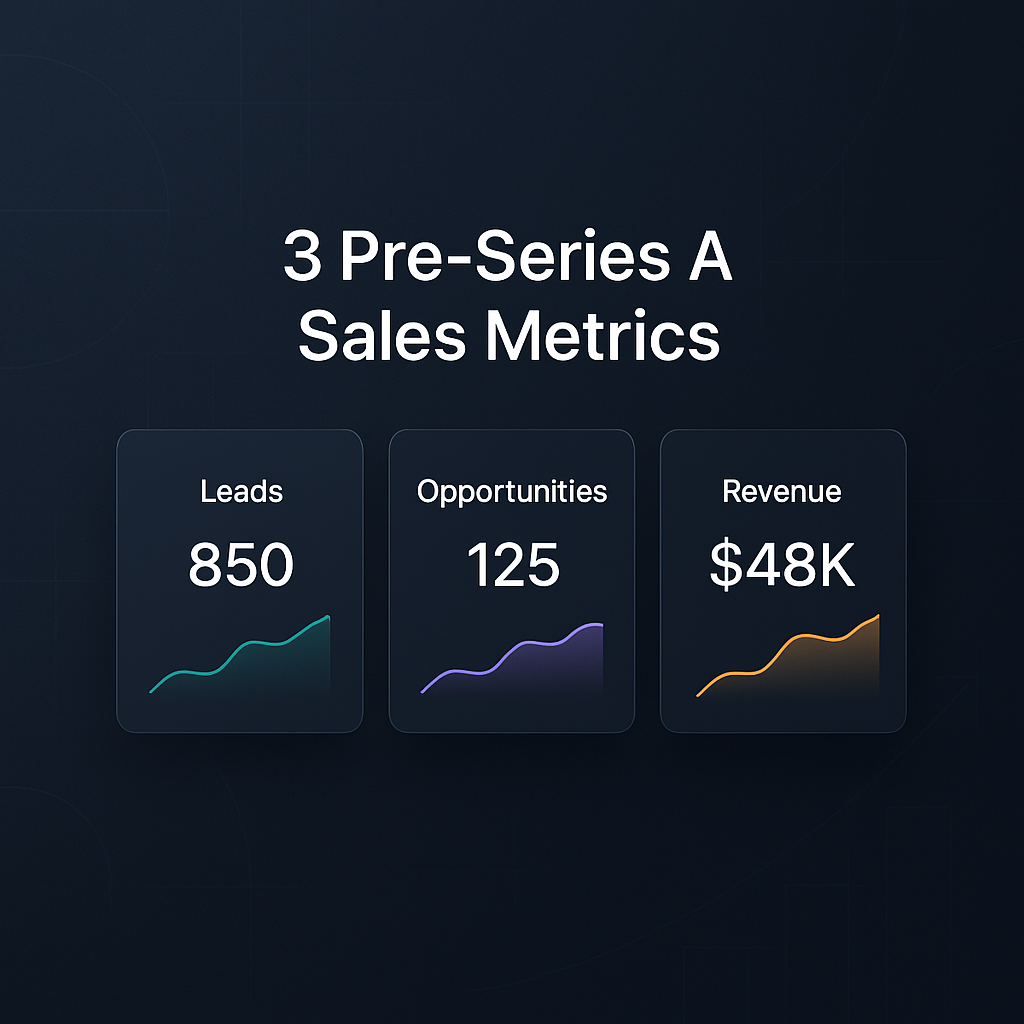
So here they are. The only 3 metrics that matter pre Series A sales.

First, a quick note on what “pre Series A” really means in sales terms
It does not mean your ARR is a specific number.
It means you are still in founder led sales, or barely transitioning out of it. You are still learning:
- Who really buys this
- Why they buy
- How long it takes
- What makes deals stall
- What a good rep would even do all day
So metrics at this stage are not about “optimizing”. They are about proving a motion exists.
If you can show a predictable path from pipeline to closed revenue, you are in a different category of company. Investors feel it. Hires feel it. You feel it.
Ok. Now the three.
Metric 1. Pipeline coverage (for your next 90 days)
This is the most important one. Because it forces honesty.
Pipeline coverage = Qualified pipeline value for a period ÷ Target bookings for that period
For pre Series A, use a simple window. Next 90 days.
Why this matters more than “pipeline created”
Because pipeline created is a vanity trap. You can create pipeline all day. Especially if you count anything that breathes.
Coverage asks a harder question.
Do we have enough real opportunities in motion to hit what we said we would hit.
What counts as “qualified pipeline” here
Not leads. Not meetings booked. Not “they liked the demo”.
Qualified means, at minimum:
- A defined problem you solve
- A real buyer or champion identified
- A timeline that makes sense
- A next step on calendar
- Some kind of mutual agreement that this is an active evaluation
If you use MEDDPICC, great. If you do not, keep it simple. Just do not lie to yourself.
What “good” coverage looks like pre Series A
Most early stage teams underestimate how much pipeline they need.
A decent starting benchmark:
- 3x coverage if you have short cycles and clear ICP
- 4x to 6x coverage if your deals are messy, enterprise, multi stakeholder, or still finding fit
Yes, that sounds like a lot. It is. That is the point. Early win rates are usually lower than you think, and timing is always later than you want.
The real reason this metric is gold
Pipeline coverage tells you what to do this week.
- If coverage is low, you need more top of funnel, more outbound, more partner motion, more founder selling. Whatever your lever is.
- If coverage is high but bookings are not happening, you have a conversion problem. Sales process, deal quality, messaging, pricing, steps. Something.
It splits the world into two buckets. Not enough pipe, or not converting pipe.
That clarity is rare.
Common mistake: counting the wrong pipeline
You add a deal because the prospect said “circle back next quarter”.
That is not pipeline. That is a contact.
Pre Series A, you need a strict definition of what enters pipeline. Or your coverage number becomes a bedtime story you tell yourself.

Metric 2. Sales cycle (median days from first meeting to close)
If pipeline coverage is the “are we safe” metric, sales cycle is the “can we predict” metric.
And it is median, not average, for a reason.
Average gets wrecked by one giant enterprise deal that took 210 days. Median keeps you honest about the typical motion.
Sales cycle (median) = Median number of days from first real sales meeting to Closed Won
Pick a clear start point. I like:
- Start: first discovery call or first demo, whichever is the first “sales conversation”
- End: contract signed
For reference on how long these cycles generally last across different sectors, you might find this resource on average sales cycle length by industry helpful.
Why sales cycle matters so much pre Series A
Because it affects everything.
- How much cash you need
- How early you need to start pipeline
- When you should hire reps
- Whether your pricing and packaging match your buyer
- Whether your ICP is truly ICP
A long sales cycle is not bad. Some great businesses have long cycles.
But an unknown sales cycle is brutal.
What you are looking for
Not perfection. A trend.
- Are cycles shortening as you learn
- Are you consistently stuck at the same stage
- Are deals with a certain persona moving faster
- Are deals with a certain segment dragging forever
This is how you find your early repeatability.
A simple way to break it down (and actually use it)
Take your last 10 closed won deals, and group by:
- Segment (SMB, mid market, enterprise)
- Use case
- Entry point persona (who the first call was with)
Then check the median days.
You will usually see it instantly. Like.
“Oh. The fastest deals start with Head of RevOps, not the VP Sales.” Or. “Enterprise deals are not slow. They are slow when legal shows up late because we did not bring security early.”
That is where process comes from. Not from random playbooks. From your data, even if it is messy.
Common mistake: thinking speed equals health
Some founders chase shorter cycles and accidentally move downmarket, discount too hard, or close low retention customers.
Sales cycle is a metric. Not a religion.
You want the right cycle for the right customer, with a predictable path through it.

Metric 3. Win rate (but only on qualified opportunities)
Win rate is the one everybody quotes. And most teams calculate it wrong.
Win rate = Closed Won ÷ (Closed Won + Closed Lost)
But the key is what you include in the denominator.
Pre Series A, you should track win rate only on opportunities that met your definition of qualified pipeline.
Not every inbound lead. Not every meeting. Not every “opportunity” a rep created because the CRM forced them to.
Why win rate matters pre Series A
Because win rate is your “product meets market” signal.
Not perfect. But directional.
If you are losing most deals after serious evaluation, it usually means one of these is true:
- Your ICP is off
- Your positioning is unclear
- Your differentiation is weak
- Your pricing or packaging does not match perceived value
- Your sales process is not controlling the evaluation
- You are talking to non buyers too often
Win rate gives you a pressure test.
What is a “good” win rate early
It depends. But rough guidance:
- 10 to 20% can be normal if you are still learning and selling into bigger orgs
- 20 to 35% is healthier and often where you start seeing repeatability
- 35%+ can happen, but be careful. Sometimes that means you are only counting easy wins and ignoring the real market, or you are underpricing
Again. Direction matters more than the exact number. The goal is to improve it by tightening qualification and tightening messaging.
The part founders miss: win rate is a lagging metric
By the time you see win rate dropping, the damage happened weeks ago.
So use it in combination with the other two metrics.
- Coverage tells you if enough pipe exists
- Cycle tells you when results should show up
- Win rate tells you if your deals are real and your motion works
Together, they explain the story.
Common mistake: optimizing win rate by avoiding hard deals
This one is sneaky.
You start cherry picking. Only tiny deals you can win. Win rate goes up. ARR quality goes down. Retention goes down. You end up with customers that do not pull the product forward.
So track win rate. But also track deal quality in your notes. Even if it is subjective for now.

How these 3 metrics actually work together (a simple diagnostic)
Here is the fast way to use them.
Scenario A: Coverage is low, win rate is fine
You can close. You just do not have enough at bats.
Fix:
- outbound volume and quality
- partner channels
- founder sourcing
- clearer ICP targeting
- better conversion from lead to qualified opportunity
Scenario B: Coverage is high, win rate is low
You are stuffing the pipeline with deals you cannot win. Or you are not controlling the sales process.
Fix:
- tighten qualification criteria
- improve discovery
- sharpen positioning and differentiation
- build a real mutual plan with prospects
- bring in the right stakeholders earlier
Scenario C: Coverage is high, win rate is fine, but bookings still miss
Your sales cycle is longer than you think. Or your “close date” is fantasy.
Fix:
- re baseline your median cycle
- stop using hope based close dates
- force next steps with dates, owners, and agreed outcomes
- update stages to reflect buyer actions, not seller actions
Scenario D: Win rate is decent, cycle is expanding
Often means you are moving upmarket without changing how you sell.
Fix:
- add enterprise proof points
- security and procurement readiness
- multi thread earlier
- stronger champions
- clearer economic buyer alignment
This is what a real early stage “sales operating system” looks like. Simple, but it tells the truth.
What I would ignore (for now)
This might annoy the spreadsheet people, but ok.
Pre Series A, I would not obsess over:
- MQLs
- SQLs as a vanity count
- activity metrics like calls per day, unless you have reps and a real baseline
- forecast category math that implies certainty you do not have
- CAC math that assumes stable inputs
Not because these are useless forever. They are just not the highest leverage right now.
If you have the three metrics above working, everything else gets easier to layer in.
A very practical setup inside your CRM (so this is not just theory)
If your CRM is HubSpot or Salesforce, you can set this up without a full RevOps hire. You just need clean definitions.
1) Define what a qualified opportunity is
Write it down. One paragraph.
Example: “A qualified opportunity is an account with confirmed problem, identified buyer or champion, target timeline within 6 months, and a next meeting scheduled.”
Keep it short. Make it enforceable.
2) Make stages reflect buyer progress
Not your internal vibes.
Bad stage names:
- Demo done
- Proposal sent
Better:
- Problem confirmed
- Stakeholders identified
- Solution validated
- Commercial terms aligned
- Procurement and legal in progress
Whatever your version is. Just make it reflect reality.
3) Add one required field that forces discipline
Like “Primary reason to buy” or “Compelling event date”.
One field. Not ten. Early stage teams break when you add too much process.
4) Build one dashboard with only these 3 tiles
- 90 day pipeline coverage
- median sales cycle
- qualified opp win rate
That is it.
If you want the bonus tile, add “new qualified pipeline created last 7 days” as an input metric. But keep the top line simple.
The subtle founder trap: you cannot delegate these metrics
Even if you hire your first AE, you still own the system.
Because pre Series A sales is not “selling”. It is productizing your selling.
This is actually a big part of what we do inside David Consulting Services. Helping founders take what is currently in their head, in their calls, in their improvisation, and turn it into something a small team can run. A documented playbook, a CRM that tells the truth, and a 90 day operating rhythm that does not rely on heroics. If that is the stage you are in, you can see the 90 Day Method and book a consult here: https://www.davidconsulting.services
Wrap up (keep this simple)
If you remember nothing else, remember this.
Pre Series A sales is not about having perfect metrics. It is about having honest ones.
Track:
- Pipeline coverage for the next 90 days
- Median sales cycle
- Win rate on qualified opportunities
Those three will tell you if you have enough pipe, if you can predict timing, and if you are actually winning the deals you should win.
Everything else is secondary. Add it later, when you have a motion worth scaling.
FAQs (Frequently Asked Questions)
What does 'pre Series A' mean in sales terms?
In sales terms, 'pre Series A' means you are still in founder-led sales or just beginning to transition out of it. At this stage, you're learning who really buys your product, why they buy, how long the sales cycle takes, what causes deals to stall, and what a good sales rep should do daily. It's less about optimizing and more about proving a repeatable sales motion exists.
What are the three key sales metrics that matter pre Series A?
The three essential metrics pre Series A are: 1) Pipeline Coverage for the next 90 days, which measures if you have enough qualified opportunities to meet your bookings target; 2) Sales Cycle, specifically the median days from first meeting to close, which helps predict revenue timing; and 3) Win Rate, which reflects how often deals in your pipeline convert into closed revenue.
How is Pipeline Coverage calculated and why is it important?
Pipeline Coverage is calculated as Qualified Pipeline Value for the next 90 days divided by Target Bookings for that period. It matters because it forces honesty about whether you have enough real opportunities to hit your goals. Unlike 'pipeline created,' coverage focuses on genuine qualified deals with defined problems, identified buyers, realistic timelines, scheduled next steps, and mutual agreement on active evaluation.
What qualifies as 'qualified pipeline' in pre Series A sales?
'Qualified pipeline' means opportunities that meet minimum criteria: a defined problem your product solves; a real buyer or champion identified; a sensible timeline; a next step scheduled on the calendar; and some mutual agreement that an active evaluation is happening. Leads or meetings alone don't count. It's crucial not to include vague contacts or stalled prospects as pipeline.
Why is median Sales Cycle important and how should it be measured?
Median Sales Cycle (days from first real sales meeting to contract signed) indicates how predictable and efficient your sales process is. Using median rather than average avoids distortion by outliers like very long enterprise deals. Tracking this metric helps understand cash flow needs, hiring timing, pricing fit, and whether your Ideal Customer Profile (ICP) is accurate—key for building repeatable sales motions pre Series A.
What common mistakes should pre Series A teams avoid when tracking these metrics?
A frequent mistake is counting unqualified opportunities as pipeline—such as prospects who say 'circle back next quarter'—which inflates coverage numbers misleadingly. Another error is ignoring median in sales cycle calculations, which can hide true typical deal length. Teams should maintain strict definitions of qualified pipeline and use median sales cycle data to get honest insights that genuinely inform next steps.