You find a company that looks perfect. Right size. Right tech stack. They raised money. They are hiring. Everything lines up.
You send a clean email to the obvious title. Maybe even a second follow up. You get a reply.
And then it happens.
“Looping in my colleague who owns this.”
Or the classic.
“I’m not the right person, but you can talk to…”
And now you are in the slow lane. The lane where deals go to die quietly. Not because your product is bad, but because you are talking to people who cannot actually decide.
So yeah, let’s talk about the fastest way to find the real decision maker. Not a trick. Not a magic LinkedIn filter. More like a repeatable process you can run in 10 to 20 minutes per account.
And once you get good at it, it changes your pipeline quality immediately.

First, what “decision maker” actually means (because people mix this up)
In B2B, the “decision maker” is rarely one person.
Most deals have at least three roles:
- Economic buyer
- Controls budget. Can say yes even if others complain. Often a VP, C level, or GM.
- Champ / power user buyer
- Feels the pain daily. Wants the thing to work. Might lead vendor selection. Often a manager or director.
- Technical / risk gatekeeper
- Security, IT, legal, procurement. They can stall you forever if you ignore them.
When founders say “I just need the decision maker,” they usually mean the economic buyer. The person who can approve spend.
But here is the reality. If you skip the champion and go straight to the top, you might get a meeting, sure. But you often lose momentum because nobody underneath is bought in.
So the fastest way is not “find the highest title.” It is “find the person who owns the problem and has enough authority to drive a decision.”
Sometimes that is the VP. Sometimes it is the Director who runs the budget line. Sometimes it is the Head of RevOps who basically runs the building.
You need the real owner.
The fastest way (in one line)
Start from the problem. Trace it to the person who is measured on it. Then confirm who can sign.
That is it.
Now let me unpack it into a practical workflow you can follow.
Step 1: Identify the “pain owner” before you identify the person
If your first step is “search on LinkedIn for VP of Something,” you are already slightly off.
The faster move is this:
Ask: what internal metric gets worse if my solution does not exist?
Examples:
- If you sell an outbound tool, the metric is meetings booked, cost per meeting, pipeline created.
- If you sell compliance software, it is audit readiness, risk exposure, time to close controls.
- If you sell customer success automation, it is churn, NRR, renewal cycle time.
Now ask: who is on the hook for that metric.
That person is usually your best “real decision maker” candidate, or the person who can walk you to them.
You are not guessing titles anymore. You are mapping accountability.
Step 2: Use the “three page scan” to narrow the org in 10 minutes
This is my favorite quick method because it is simple and it works even when LinkedIn is messy.
You scan three things, in this order:
1) The company’s leadership page (or About page)
Look for functional leaders and how they phrase responsibilities.
Words that matter:
- “Owns”
- “Leads”
- “Responsible for”
- “Scaling”
- “Operating system”
- “Go to market”
Those phrases are breadcrumbs. You are looking for who is accountable, not who is famous.
2) Job postings in the department you sell into
Job descriptions are basically internal truth leaking out.
If a company is hiring a “Director of RevOps” and the description says “partner with Sales leadership to improve forecasting and pipeline hygiene,” you just learned where that problem sits.
Also. Job postings often list who the role reports to. That is gold.
3) Recent content that mentions the initiative
This can be:
- press releases
- webinars
- podcasts
- LinkedIn posts from leaders
- conference speaker pages
Search:
site:company.com “pipeline”
site:company.com “security”
site:company.com “SOC 2”
or just “Company + keyword” on Google.
The person talking publicly about the initiative is often the person driving it internally.
Step 3: Build a “DM hypothesis” instead of hunting a unicorn
Most reps waste time trying to find the one perfect contact.
Stop doing that.
Do this instead:
Pick 2 to 4 contacts per account and label them:
- Pain owner (primary)
- Economic buyer (likely signer)
- Influencer / technical gatekeeper
- Adjacent leader (backup route)
Now you have a mini map. Even if you start with the wrong person, you have a plan to route fast.
A simple example for a sales tech product:
- VP Sales: economic buyer
- Head of RevOps: pain owner
- Sales Enablement: influencer
- IT/Security: gatekeeper
You are not just “sending emails.” You are running a short decision process.
Step 4: Confirm the decision maker using one direct question (that doesn’t feel weird)
When you get someone on a call, you do not need to play politics. You just need to ask cleanly.
Here are a few lines that work without sounding like a robot:
- “When teams like yours roll this out, who usually owns the final go ahead?”
- “If this works and we want to move forward, what does the internal decision process look like?”
- “Who else will want to weigh in, even if they are not on this call?”
- “Is budget owned inside your team, or do we need alignment with finance or leadership?”
Notice what is happening.
You are not asking “Are you the decision maker?” which puts people on defense.
You are asking about process. People love talking about process. And it reveals power.
Step 5: Use the “calendar test” to spot fake authority fast
This is a sneaky one but it is real.
Ask for something small that requires influence, not budget.
Examples:
- “Can we bring in your security lead for 10 minutes next call?”
- “Can we pull in your VP for the last 10 minutes to confirm priorities?”
- “Can you share a sample of how you measure this today?”
If they can do those things quickly, they have internal pull.
If they say “Yeah maybe in a few weeks” and nothing happens, you are likely dealing with a nice person who cannot move anything.
Not their fault. But you need to know early.
Step 6: The fastest outbound path is often sideways, not up
Here is something founders hate hearing, but it is true.
Going straight to the C suite is not always fastest.
Sometimes the fastest path is:
Start with the person one level below, win them, then climb together.
Because internally, the champion speaks the language. They know what matters. They know which landmines to avoid. They know how procurement actually works at their company.
So yes, you want the economic buyer involved. But you often get there faster by building a champion first, then using them as your internal GPS.
That is how enterprise deals actually move.
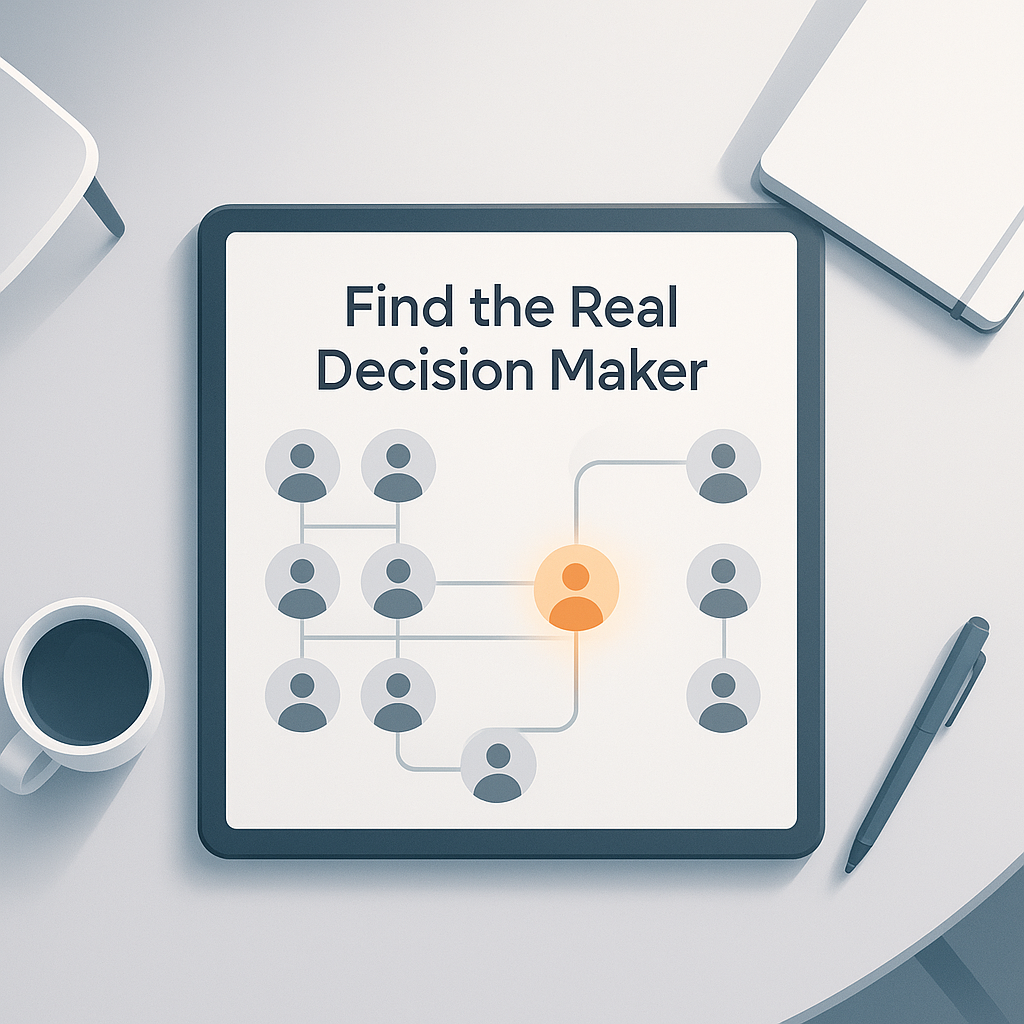
A simple visual: what you are building (a decision map)
Here is the rough structure you want for each target account.

Account: Acme Corp
- Pain owner: Director of Ops
- Economic buyer: VP Ops
- Gatekeeper: Security + Procurement
- Users: Analysts / team leads
- Champion strength: high / medium / low
- Next step to confirm: “Who signs and what is the process?”
If you do this for 20 accounts, your pipeline becomes way cleaner. Less random meetings. More deals that can actually close.
Common reasons you keep missing the real decision maker
This is the part that stings a bit.
1) Your message is too generic, so only low power people reply
Senior buyers ignore generic outbound. They are busy. They have seen it all.
Generic messaging tends to attract:
- junior roles
- “researching options” people
- folks who want to be helpful but cannot buy
So if your reply rate is decent but deal progression is terrible, that can be why.
2) You are selling “features” instead of a business outcome
Decision makers buy outcomes. This is where outcome-based selling comes into play.
Champions might care about features. But the signer cares about risk, cost, time, growth.
If your pitch does not connect to a metric they own, you will keep getting delegated. Understanding how they measure success and the specific product metrics they focus on can be key in this scenario.
3) You do not ask about process early enough
People wait until proposal stage to ask “So who signs?”
That is too late.
Ask by the end of call one. Maybe call two. But early.
The quick script I like for finding the real owner (copy and use it)
Here is a short version you can run on discovery calls.
1) Confirm problem + impact
“Just to confirm, the main issue is X, and it’s showing up as Y. Is that accurate?”
2) Ask how it’s measured
“How do you measure success today? What number gets reviewed?”
3) Ask who is accountable
“Who is ultimately accountable for that number?”
4) Ask about decision path
“If we agree it’s worth fixing, what are the steps to get this approved internally?”
This sequence is fast. It is respectful. And it reveals the truth.
What to do when you realize you are not talking to the decision maker
Do not panic and do not “ask for an intro” in a weak way.
Do this:
- Make them feel smart for being involved
- “It makes sense you’re looking at this since you’re closest to the workflow.”
- Invite the decision maker into a specific moment
- “Could we bring in your VP for the last 10 minutes next call so we can confirm priorities and the budget range?”
- Give them a role
- “You can stay as the lead on requirements, but we’ll want alignment from leadership before we design anything.”
You are not kicking them out. You are upgrading the meeting.
This gets even easier when your sales process is documented
If you are a founder doing founder led sales, this whole “find the real decision maker” thing often lives in your head.
You just know who to ask for. You have intuition. You have been on enough calls.
But the moment you hire reps, everything breaks a little. Because they do not have your instincts. They do not know your patterns yet. So they chase titles. They follow replies. They get stuck with non buyers.
This is one of the reasons we built the 90 Day Method at David Consulting Services.
Not to hand you some generic playbook. But to extract what works in your sales motion and turn it into something your team can actually run. Including stuff like:
- how to map stakeholders fast
- how to qualify using a real framework (MEDDPICC, Challenger, SPIN, Sandler, whatever fits your deal)
- how to spot authority early
- how to run clean next steps and multi thread properly
If you want help turning founder instincts into a repeatable system your first 1 to 3 reps can follow, you can check out the process here: https://www.davidconsulting.services
A last note that is annoyingly true
The fastest way to find the real decision maker is not a tool.
Tools help, sure. LinkedIn, Crunchbase, Apollo, whatever.
But the real speed comes from doing two things consistently:
Do that, and you stop running in circles. Your pipeline gets smaller in the best way. Less noise. More real deals.
And honestly, you will feel calmer. Because you will know exactly where you are in the account. Who matters. Who doesn’t. Who can sign. Who can stall you.
That is the game.
FAQs (Frequently Asked Questions)
What does 'decision maker' mean in B2B sales?
In B2B, the 'decision maker' usually involves multiple roles: the economic buyer who controls budget and can approve spend (often a VP or C-level), the champion or power user who feels the pain daily and leads vendor selection (often a manager or director), and the technical or risk gatekeeper such as IT, security, or procurement who can stall decisions. The real decision maker is often the person who owns the problem and has enough authority to drive a decision.
Why is it important to identify the 'pain owner' before searching for decision makers?
Identifying the 'pain owner' means understanding which internal metric worsens without your solution and who is accountable for that metric. This approach maps accountability rather than guessing titles, helping you find the person most invested in solving the problem and likely to be a real decision maker or guide you to one.
What is the 'three page scan' method for quickly narrowing down decision makers?
The 'three page scan' involves reviewing (1) the company's leadership or About page to find functional leaders with accountability keywords like 'owns' or 'leads'; (2) job postings related to your target department to glean responsibilities and reporting lines; and (3) recent company content such as press releases, webinars, or LinkedIn posts mentioning relevant initiatives. This helps identify who drives key projects internally within 10 minutes.
How should I build a decision maker hypothesis instead of searching for one perfect contact?
Instead of hunting for a single perfect contact, pick 2 to 4 contacts per account and categorize them as pain owner (primary), economic buyer (likely signer), influencer/technical gatekeeper, and adjacent leader (backup route). This creates a mini organizational map allowing you to route conversations quickly even if you start with someone not fully empowered.
What is an effective way to confirm who the real decision maker is during a call?
You can ask direct but natural questions like, 'When teams like yours roll this out, who usually owns the final go ahead?' or 'If this works and we want to move forward, who signs off on that?' These questions avoid playing politics and help clarify decision authority without sounding robotic.
Why does contacting only high-level executives sometimes slow down sales momentum?
Going straight to top executives without engaging champions underneath often loses momentum because those directly affected by the problem aren't bought in. The fastest way is finding someone who owns the problem with enough authority—sometimes a director or head of operations—not necessarily just the highest title.