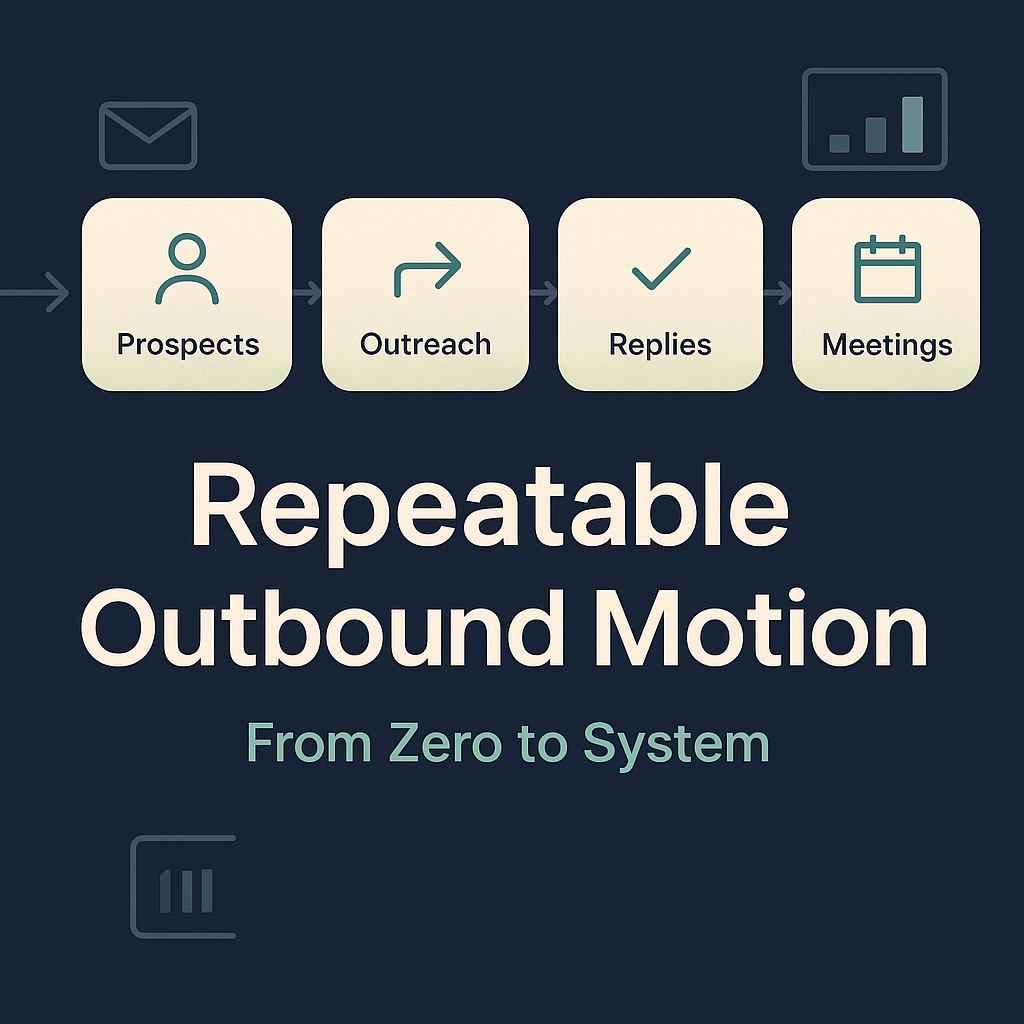
Some people treat it like magic. Others treat it like spam. Most founders… kind of do it in bursts. They do a week of LinkedIn messages, then a couple cold emails, then they go back to product because it feels cleaner.
But the real issue is simpler than that.
If you do not have a repeatable outbound motion, you do not actually have outbound. You have vibes. And a few lucky replies.
This is how you go from zero to something you can run every week, measure, and eventually hand off to a rep without everything falling apart.
Not overnight. Not perfectly. Just repeatable.

What “repeatable outbound” actually means
A repeatable outbound motion is not “we send cold emails.”
It is a system where:
- You know exactly who you target and why
- You know exactly what you say and what you do not say
- You can generate a predictable number of conversations per week
- You track the same few numbers every week
- Someone else can execute it with your guidance, not your brain
And yeah, it still takes skill. But it stops being this emotional rollercoaster.
When you start from zero, the biggest trap is trying to scale before you can even explain what is working.
So we build it in layers.
Layer 1. Pick one ICP you can actually win
You cannot outbound your way out of unclear positioning.
You can brute force it for a bit, sure. But you will burn lists, burn domains, burn your confidence. Then you will decide outbound does not work.
So start narrow. Like, uncomfortably narrow.
Instead of:
- “B2B SaaS”
- “Marketing teams”
- “Mid market”
Try:
- “Series A B2B SaaS selling to security teams, with deal cycles longer than 60 days”
- “VP RevOps at a company with 10 to 40 AEs, using Salesforce, struggling with forecast calls”
- “Head of IT at US healthcare orgs, 1k to 5k employees, migrating from on prem tools”
You want an ICP where three things are true:
- They have a painful problem right now
- They can pay
- You can plausibly get a meeting without being famous
If you are not sure, do this simple check: can you name 20 companies off the top of your head that fit? If not, your ICP is still fuzzy.
Micro decision that matters a lot
Pick a single primary persona for outbound. Not “C suite and director level.” One.
You can add other personas later. But early outbound needs focus, otherwise you never learn.

Layer 2. Build a list you trust (before you build sequences)
Most outbound fails because the list is wrong, not because the copy is bad.
A good list has:
- The right company filters
- The right titles
- A believable reason those companies would care now
- Enough volume to run weekly
If you are starting from zero, do not start with 10,000 leads. Start with 150 to 300 that are extremely clean.
A simple list building workflow (that does not get fancy)
Step 1: Define company filters
Identify the characteristics that define your ideal customer companies:
- Industry
- Employee range
- Geography
- Funding stage or revenue proxy
- Tech stack signals if relevant
Step 2: Define persona and titles
Be specific about who you want to reach:
- Include 5 to 10 title variations, max
- Exclude titles you cannot sell to yet
Step 3: Pull the list
Use your available tools and clean the data:
- Apollo, ZoomInfo, Clay, LinkedIn Sales Navigator, whatever you have
- Export and clean it. Yes, manually. Early on, you want your hands on the data.
Step 4: Spot check 25 records
Validate the quality before you proceed:
- Are these companies real fits or just "kind of"
- Would you personally take this call if you were them
- Is the persona accurate
If this part is sloppy, everything downstream becomes noise.
Layer 3. Decide what you are offering (and keep it boring)
Outbound is not the place to be poetic.
Your offer is basically: why should they take the meeting.
Early stage founders often pitch the product. Or they pitch the company story. Or they pitch a giant transformation.
A repeatable outbound offer is smaller. Clearer. Easier to say yes to.
Some examples of outbound friendly offers:
- "15 minute teardown of your current inbound to outbound handoff"
- "Benchmark report for how similar teams are running X"
- "A quick idea on how to reduce time to first value for Y"
- "A short walkthrough of how teams like you are solving Z, and whether it applies"
Notice what is missing. No huge promises. No "revolutionize." No 45 minute demo request in the first email unless you are already in high intent land.
You are not closing in cold outbound. You are opening.
Layer 4. Build messaging from triggers, not features
If your outbound message is basically a brochure, people will treat it like a brochure.
Instead, anchor your messaging on a trigger.
Triggers are things that make your email feel like it was sent for a reason, not at random.
Good triggers:
- Recent funding round
- Hiring for roles that imply a pain (RevOps, SDR manager, security, compliance)
- Tool adoption or migration (Salesforce, HubSpot, Snowflake, etc.)
- New product launch
- Expansion into a new market
- A clear operational symptom (long deal cycles, forecast misses, churn, low activation)
Then you connect the trigger to the likely pain. Not aggressively. Just logically.
A plug and play structure that works
- Trigger + observation
- Problem hypothesis (one line)
- Proof (mini, specific)
- Soft CTA
Example skeleton:
Saw you just [trigger]. Usually when teams do that, [problem] shows up fast.
We helped [similar company type] solve [specific result].
Worth a quick chat to see if it is relevant?
Keep it simple. You can add personality later. Repeatable comes first.

Layer 5. Pick channels and commit to one primary motion
If you try to do email, LinkedIn, calls, events, partnerships, and ads at the same time, you will not learn what is working. You will just be busy.
A clean starter outbound motion is usually:
- Cold email as the primary channel
- LinkedIn as a light assist
- Calls only if your market expects it (or you have the stomach for it)
For effective cold email subject lines, commit for 30 days.
Not “we tried for a week and it did not work.” A real cycle.
When dealing with tool adoption or migration like moving to the cloud, having email templates tailored to specific triggers can significantly improve your outreach effectiveness.
Layer 6. Set up the minimum viable outbound stack
Do not overbuy tools. But also, do not run outbound from your personal Gmail with a CSV file.
Minimum stack:
- A CRM (HubSpot, Pipedrive, Salesforce, whatever you use)
- A sequencing tool (Apollo, Salesloft, Outreach, HubSpot sequences)
- A domain and inbox setup for cold email (separate from your main domain)
- A way to verify emails (NeverBounce, Zerobounce, etc.)
- A basic enrichment source (often built into Apollo, ZoomInfo, Clay)
Inbox setup basics (quick but important)
- Use 2 to 4 inboxes to start, not 20
- Warm them up gradually
- Keep daily send volume low at first
- Make sure SPF, DKIM, DMARC are configured
If you skip this, you will think your copy is bad. Really you are just landing in spam.
Layer 7. Write sequences that are designed to learn
Most sequences are too long, too vague, and full of “just circling back.”
For a brand new outbound motion, you want fewer steps and clearer hypotheses.
A solid starting point:
- 4 emails over 12 to 15 business days
- 1 LinkedIn connect (optional)
- 1 LinkedIn follow up (optional)
What each step should do
- Email 1: trigger based, clean value hypothesis
- Email 2: different angle, same problem
- Email 3: proof and specificity, a short micro case
- Email 4: breakup but still useful, easy out
Also, keep each email readable on a phone. Short paragraphs. One idea per message. It matters.
Example Email 1 (simple and sane)
Subject: quick question about {{trigger}}
Hi {{first_name}}
Noticed {{trigger}}. When that happens, I usually see {{pain}} pop up in the next 30 to 60 days.
We have been helping {{similar_companies}} tighten up {{specific_outcome}} without adding headcount.
Open to a quick 15 min chat next week to see if it is relevant?
Thanks
{{name}}
That is it. No essay. No product tour.
Layer 8. Define your weekly operating cadence
This is where “repeatable” becomes real.
Pick a weekly cadence you can run even when you are busy. Especially when you are busy.
A simple founder friendly cadence:
- Monday: build or refresh 50 to 100 leads
- Tuesday: launch sequences
- Wednesday: respond fast, book meetings, do follow ups
- Thursday: review stats, adjust one thing
- Friday: write 1 new message variant, prep next week
Outbound is not “set and forget.” But it also should not take your whole life.
Layer 9. Track the few metrics that actually matter
Do not drown in dashboards.
Track these weekly:
- Leads added
- Emails sent
- Positive reply rate
- Meetings booked
- Show rate
- Opportunities created (if applicable)
Early benchmarks (very rough, varies by market):
- Positive reply rate: 1 to 5 percent is common early
- Meeting rate from cold: 0.3 to 1.5 percent depending on ICP and offer
- Show rate: should be high if you confirm properly
If open rates are low, it can be deliverability. If open rates are fine but replies are dead, it is usually list quality or message relevance.
Layer 10. Run structured experiments, not random tweaks
Founders love to tweak copy. New subject line. New CTA. New template. New everything.
The problem is you do not know what caused the change.
So do this instead:
- Change only one variable at a time
- Run it on a meaningful sample (at least 100 to 200 sends per variant if possible)
- Keep a simple log of what you changed and why
Examples of good experiments:
- Trigger based vs non trigger opener
- Persona A vs Persona B
- Offer 1 vs Offer 2
- Case study proof vs metric proof
- Short email vs slightly longer email
You are trying to find the smallest repeatable unit that produces meetings.

Layer 11. What to do when replies come in (this is where most teams fumble)
If you finally get replies and then you respond 2 days later with a calendar link and no context… you are wasting the hardest part.
Rules for handling inbound replies from outbound:
- Reply fast. Same day if possible.
- Match their tone. Keep it human.
- Answer their question directly.
- Offer 2 specific time windows, not just “here is my calendar.”
- Confirm the agenda in one sentence.
Example:
Totally fair. We usually start by looking at {{thing}} and where deals stall, then I will share what we see working for similar teams.
Does Tue 11am ET or Wed 2pm ET work?
That alone can bump your booked meeting rate.
Layer 12. Turn founder outbound into a playbook (so you can hand it off)
Here is the uncomfortable truth.
Founder led outbound can work even when it is messy because you have intuition and context. But a rep cannot read your mind. They need a playbook.
Your playbook should include:
- ICP definition and exclusions
- Target account criteria and examples
- Persona and titles
- Triggers you use
- Message templates and why they work
- Objection handling snippets
- Meeting agenda and qualification criteria
- Handoff rules into pipeline stages
- Weekly activity targets
- What “good” looks like in metrics
This is exactly the kind of work that tends to happen inside a structured engagement. If you want help extracting what is already in your head and turning it into a repeatable system, that is basically the core of the 90-Day Method at David Consulting Services. Playbook, process, pipeline, sequences, reporting. And then hiring and training the first reps without chaos.
Not a “download this template” thing. More like, we actually build the machine with you.
Common mistakes when building outbound from zero
Mistake 1: Starting with automation before clarity
If you cannot explain why someone should care, no tool fixes that.
Mistake 2: Targeting too broad because you want more leads
Broad ICP equals generic messaging equals low replies. Then you assume outbound does not work.
Mistake 3: Over pitching the first message
Cold outbound is not the pitch. It is the doorway.
Mistake 4: No operational cadence
If you only do outbound when you feel like it, you cannot measure it. And you definitely cannot scale it.
Mistake 5: Not capturing learnings
Every week you should be smarter. If you are not, you are just sending more noise.
A simple 30-day plan (from nothing to repeatable)
If you want a practical timeline, here is a clean one.
Week 1: Foundations
- Pick ICP and primary persona
- Build first 200 lead list
- Set up inboxes and sequencing tool
- Draft 2 message variants based on 2 triggers
Week 2: Launch and observe
- Send to 50 to 100 leads
- Reply fast
- Log objections and questions
- Fix obvious deliverability issues
Week 3: Improve relevance
- Tighten list filters based on what you learned
- Add proof points, make messaging more specific
- Test a new offer angle
Week 4: Lock the cadence
- Standardize weekly lead flow
- Pick the best performing message variant
- Document the process in a simple playbook
- Decide whether to scale volume or add a second persona
At the end of 30 days, you might not have a flood of pipeline. But you will have a motion. Something you can run again.
That is the win.
Wrap up
Repeatable outbound is boring in the best way.
It is: clean targeting, trigger based messaging, a steady weekly cadence, and just enough tracking to know what is working. Then you document it, and eventually it becomes something your first SDR or AE can run without you hovering.
If you are trying to go from founder led hustle to an actual sales engine, and you want help building the playbook, sequences, pipeline stages, and coaching the first reps through early deals, you can book a consultation at David Consulting Services. That is the whole focus.
Start small. Run it weekly. Learn fast. Keep it human.
FAQs (Frequently Asked Questions)
What does 'repeatable outbound' mean in the context of sales outreach?
A repeatable outbound motion is a system where you know exactly who you target and why, what you say and what you do not say, can generate a predictable number of conversations per week, track consistent metrics weekly, and someone else can execute it with your guidance—making the process scalable and reliable rather than sporadic or based on luck.
Why is it important to pick one Ideal Customer Profile (ICP) when starting outbound sales?
Picking one ICP that you can actually win is crucial because it ensures your positioning is clear and focused. A narrow ICP helps avoid burning through lists, domains, and confidence by targeting customers who have a painful problem right now, can pay, and are accessible without needing to be famous. This focus improves learning and effectiveness in early outbound efforts.
How should I build a trustworthy prospect list for outbound campaigns?
Start by defining company filters such as industry, employee range, geography, funding stage, or tech stack signals. Then specify persona titles carefully (5 to 10 variations max). Use tools like Apollo or LinkedIn Sales Navigator to pull data but clean it manually. Finally, spot check at least 25 records to ensure companies fit well, personas are accurate, and the list quality is high before proceeding.
What kind of offers work best in outbound messaging?
Outbound offers should be clear, simple, and easy to say yes to—avoiding big promises or complex pitches. Examples include brief teardowns of current processes, benchmark reports for similar teams, quick ideas to improve specific metrics, or short walkthroughs of relevant solutions. The goal is opening conversations rather than closing deals immediately.
Why should outbound messaging be built around triggers instead of features?
Messaging anchored on triggers—specific events or pain points relevant to the prospect—feels more personalized and timely than generic feature lists. Trigger-based messages are more likely to engage recipients because they address immediate concerns or situations rather than sounding like brochures promoting product features.
What common mistakes do founders make when doing outbound sales?
Founders often treat outbound like magic or spam and do it in bursts without a repeatable system. They might try scaling too early before understanding what works or pitch overly broad ICPs leading to wasted effort. Additionally, poor list quality and unfocused messaging contribute to inconsistent results and emotional ups and downs instead of steady growth.